
Hi! I'm Jessica Fanning, Founder and CEO of Natural Acne Clinic. This blog post is a personal one for me, as it took 15 years of education and research to figure out how to clear my own hormonal acne.
I launched Natural Acne Clinic out of my passion for sharing the truth about acne and helping others understand how hormonal acne can be treated naturally. After working with thousands of acne clients, I've learned that there's rarely just one thing contributing to persistent breakouts.
My hope is to help clear up some of the myths and misinformation surrounding hormonal acne, because I know firsthand how frustrating it can be.
One of the biggest misconceptions I see is that natural or holistic approaches can't be as effective as prescription acne treatments. Not true!
Prescription medications, including antibiotics, hormonal therapies, and isotretinoin (commonly known as Accutane), can be very effective for some people. But they don't work for everyone, and certain medications come with side effects or limitations on how long they should be used.
In our experience, we've also worked with many clients whose acne improved while taking a prescription, only to return after they stopped. That doesn't mean prescription treatments are bad or ineffective. It means that, for some people, there may be additional factors worth investigating.
At Natural Acne Clinic, we believe in looking at the whole picture. That includes your hormones, diet, stress levels, gut health, and the skincare products you're using every day.
The Link Between Our Hormones and Acne
Before we dive into the different ways to treat hormonal acne naturally, let's first discuss how hormones actually trigger breakouts.
Bear with me for a moment while we have a mini biology lesson!
Hormones play a major role in the development of acne, particularly a group of hormones called androgens.
Androgens are often called "male hormones," but they're present in both men and women. They're produced by the ovaries, testes, and adrenal glands. Two of the most well-known androgens are testosterone and dihydrotestosterone (DHT).
Here's where things get interesting.
Research has shown that our sebaceous glands (the glands responsible for producing oil) contain androgen receptors. Cells involved in the hair follicle also respond to these hormones.¹
When androgens interact with these receptors, they can stimulate oil production and contribute to the conditions that lead to clogged pores, bacterial activity, and inflammation.
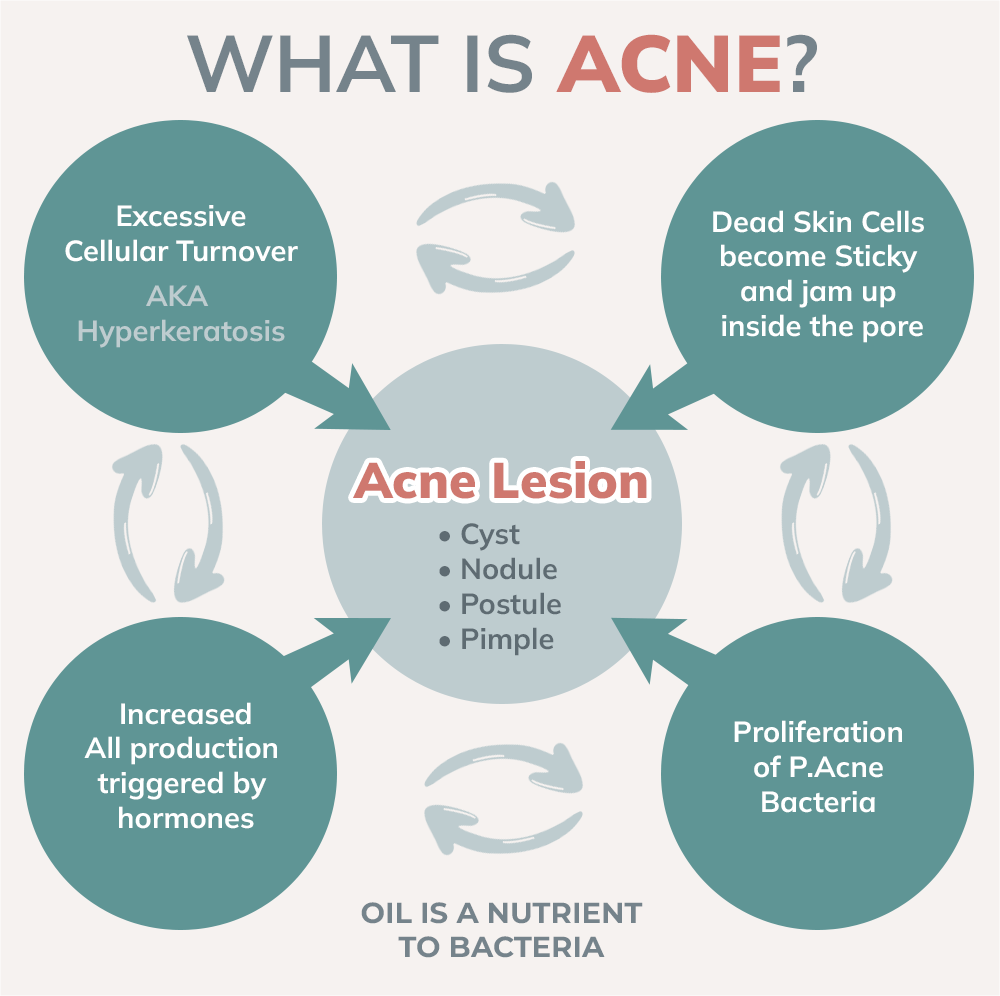
Something else that's important to understand is that you don't necessarily need to have abnormally high testosterone levels to experience hormonal acne.
Some people have perfectly normal blood hormone levels, but their skin is particularly sensitive to androgen activity.¹
That's why addressing excessive androgen activity, or reducing how strongly the skin responds to it, can sometimes help improve stubborn hormonal breakouts, especially along the chin and jawline.
So, How Does Estrogen Play Into All This?
I like to explain estrogen and testosterone using the example of a teeter-totter. These hormones interact with one another, and changes in their relative activity can influence what's happening in the skin.
Of course, our endocrine system is more complicated than a simple teeter-totter! Estrogen and testosterone don't always move in opposite directions, and hormonal acne isn't automatically a sign of low estrogen or high testosterone.
This is one reason I'm cautious about supplements marketed to "balance estrogen," particularly DIM (diindolylmethane).
At Natural Acne Clinic, we've worked with clients who experienced worsening breakouts while taking DIM. In more than a decade of working with acne clients, I've actually seen DIM cause more problems than benefits for some individuals.
DIM influences estrogen metabolism, and a 2024 dermatology review discusses its hormone-related activity and potential side effects.³ It's not a supplement I routinely recommend for hormonal acne.
The important takeaway is that understanding how your hormones are affecting your skin is often more useful than assuming everyone with hormonal acne needs the same supplement.

What Causes Hormonal Acne?
Hormonal acne can be influenced by several factors, including menstrual-cycle changes, pregnancy, certain contraceptives, stress, and conditions such as polycystic ovary syndrome (PCOS).
Diet and other lifestyle factors can also contribute to acne severity.
One thing we see frequently at Natural Acne Clinic is that clients don't always realize how many factors can be contributing at the same time.
Polycystic Ovary Syndrome (PCOS)
PCOS is a hormonal and metabolic condition that can involve elevated androgen activity, irregular ovulation, and insulin resistance.
Common symptoms include irregular or missed periods, acne, excess facial or body hair, and thinning hair on the scalp. Some people also develop darker, velvety areas of skin, particularly around the neck or underarms.
Not everyone with PCOS has all of these symptoms, and having hormonal acne doesn't automatically mean you have PCOS.⁴
If you're experiencing persistent acne along with irregular menstrual cycles or other signs of elevated androgen activity, it's worth speaking with your healthcare provider about whether further evaluation is appropriate.
Birth Control and Hormonal Acne
This is a big one, particularly for women who developed acne after starting, stopping, or switching birth control.
Over more than a decade of working with thousands of women, we've consistently seen certain contraceptives associated with worsening acne, especially in individuals who are already acne-prone.
Some of the biggest offenders we've observed include:
Hormonal and copper IUDs
Certain low-dose or low-estrogen birth control pills
Birth control implants
Birth control injections
Research supports the idea that different contraceptive methods can affect acne differently.
A 2020 study published in Obstetrics & Gynecology found that women using copper IUDs and hormonal IUDs had a slightly higher likelihood of seeking medical treatment for acne compared with women using combined birth control pills.⁵
Another study involving 2,147 women found that hormonal IUDs, implants, and contraceptive injections were associated with worsening acne on average, while certain combined birth control pills were associated with improvement.⁶
One thing that's important to understand is that the specific type of birth control matters.
Copper IUDs don't contain hormones, but we've still seen significant acne flare-ups in clients using them. Changes in contraception, including discontinuing a birth control pill that was previously helping suppress acne, may also influence what happens to the skin.
With birth control pills, the specific progestin and the combination of hormones can make a difference. We've noticed problems with certain lower-estrogen formulations in our clients, although estrogen dose alone doesn't determine whether a pill will improve or worsen acne.
At Natural Acne Clinic, we don't recommend starting birth control solely as a way to manage hormonal acne when other appropriate treatment options are available. However, we absolutely recognize that contraception is necessary or beneficial for many women.
If you're acne-prone and need birth control, I recommend reviewing your options with your prescribing provider and choosing a formulation that considers both your contraceptive needs and your skin.
How to Treat Hormonal Acne Naturally
Now that we've covered what's happening internally, let's talk about what we can actually do about it.
At Natural Acne Clinic, our approach combines appropriate skincare with personalized recommendations for hormonal support, nutrition, stress management, and overall health.
1. Vitamins and Herbs for Hormonal Acne
There are several supplements we consider when working with clients who have hormonally influenced acne.
However, not everyone needs the same supplements, and taking more isn't necessarily better.
Vitex agnus-castus, also called chasteberry, is an herb traditionally used to support menstrual health.
Research suggests that certain Vitex preparations may help with premenstrual symptoms, including breast tenderness and other symptoms related to the menstrual cycle.⁷
At Natural Acne Clinic, Vitex is one of the herbs we frequently consider when a client's breakouts appear closely connected to menstrual-cycle changes.
In our experience, it can be a wonderful addition for appropriately selected clients, particularly when hormonal fluctuations are contributing to persistent inflamed acne.
We look at each client's health history, symptoms, and skincare regimen rather than relying on Vitex alone.
Because Vitex affects hormone-related pathways, it isn't appropriate for everyone, particularly during pregnancy or breastfeeding or when certain hormonal conditions or medications are involved.⁷

Saw Palmetto is another herb we frequently consider for clients showing signs of androgen-related acne.
Saw palmetto has been studied for its potential antiandrogenic activity, including its influence on 5-alpha-reductase, an enzyme involved in converting testosterone into the more potent androgen DHT.⁸
At Natural Acne Clinic, we've seen wonderful improvement in some clients with stubborn inflamed acne, especially along the chin, jawline, neck, and even the body, when saw palmetto is incorporated into a complete personalized plan.
We've also worked with clients who previously experienced significant improvement while taking prescription spironolactone but wanted or needed to discontinue it because of side effects or other circumstances.
In some of these clients, we've seen similarly encouraging results when saw palmetto was introduced as part of their personalized acne program.
Of course, any changes to a prescribed medication should be discussed with the prescribing provider. Saw palmetto also isn't recommended during pregnancy or breastfeeding.⁹

Omega-3 fatty acids are another important part of our approach to hormonal acne, particularly because of their role in supporting a healthy inflammatory response.
The two omega-3s we're especially interested in are EPA and DHA.
Research has shown that omega-3 supplementation may help improve acne. In a 2014 randomized controlled study, participants receiving omega-3 fatty acids experienced improvements in both inflammatory and non-inflammatory acne lesions.¹⁰
At Natural Acne Clinic, we frequently incorporate omega-3 support into personalized acne programs, particularly when inflammation is a major concern.
Omega-3s are also especially valuable when we're working with clients who may not be candidates for direct hormone-modulating herbal supplements.
This includes younger clients, pregnant women, and women who are breastfeeding.
In these situations, we may turn to omega-3s as an additional source of nutritional and anti-inflammatory support while continuing to address the other factors contributing to acne.
Omega-3s are important nutrients throughout life, including during pregnancy and breastfeeding. We evaluate the appropriate source, formulation, and amount for each client, coordinating with their healthcare provider when needed.¹¹

2. Your Diet Matters More Than You May Think
Food is another area that I believe deserves much more attention when discussing hormonal acne.
We know that diet can influence metabolic and hormonal pathways associated with acne, including insulin and insulin-like growth factor 1 (IGF-1).¹²
These pathways can influence androgen activity, oil production, and inflammation.
But there's something else I want to emphasize: not everyone reacts to the same foods.
After working with acne clients for more than a decade, we've consistently observed that certain foods seem to aggravate hormonally influenced breakouts in susceptible individuals.
Some of the foods that particularly stand out to us include:
Peanut products
Soy products
Foods containing certain oils, including canola oil
These are foods we've repeatedly identified as possible contributors when working with clients experiencing hormonal acne.
This isn't an all-inclusive list of the dietary triggers we evaluate at Natural Acne Clinic. It's simply a few of the foods we've noticed coming up more frequently when hormones appear to be part of the problem.
During our acne-clearing program, we ask clients to temporarily reduce or replace the foods on our acne-trigger list while we work toward getting their skin consistently clear.
Once they're clear, we help them gradually experiment with reintroducing appropriate foods to determine which ones their skin can tolerate. This structured process helps us limit potential triggers during the clearing phase and better evaluate individual responses.
Because nutritional needs vary, we personalize dietary restrictions when necessary, especially for younger clients or anyone with medical or nutritional concerns.
Focus on Supporting Healthy Hormone Function
In addition to identifying potential food triggers, we encourage clients to focus on eating a balanced diet with plenty of vegetables, fiber, and minimally processed foods.
Research has found that higher-glycemic diets can influence insulin-related pathways and are associated with greater acne severity.¹²
Supporting stable blood sugar and eating a nutrient-rich diet are practical ways to support metabolic health, which is especially important when insulin resistance or androgen activity is contributing to acne.
The goal isn't to make eating feel restrictive or complicated forever. It's to understand the factors affecting your skin and develop habits that support clearer skin long-term.

3. Stress Reduction — Yes, It Really Does Matter!
Let's talk about stress.
These days, it seems like we're all juggling a million things, and our bodies don't always appreciate it!
If you've ever noticed your skin becoming more reactive during a stressful period, you're definitely not alone.
Research has found a connection between psychological stress and acne severity.¹³
Stress activates hormonal and inflammatory pathways that can influence what's happening in the skin, including the activity of the sebaceous glands.
And this is important: stress doesn't necessarily have to be the original cause of your acne to make it worse.
At Natural Acne Clinic, we consider stress an important contributing factor, particularly when working with clients who have persistent inflamed acne and signs of hormonal involvement.
That's why we take the time to discuss things like sleep, stress levels, lifestyle habits, and overall wellness when building a personalized acne plan.
Depending on the client, we may also consider nutritional support or supplements as part of their broader wellness routine.
The key is understanding that your skincare routine and what's happening internally are connected. Supporting your body's ability to manage stress is another piece of the acne-clearing puzzle.

4. Don't Forget About Your Gut Health
Here's another area I think deserves more attention: the connection between gut health, hormones, and our skin.
Our digestive system does much more than simply process food.
Researchers have discovered that certain gut bacteria participate in estrogen metabolism.
Some bacteria produce enzymes that influence whether estrogen metabolites are eliminated or reabsorbed through a normal process called enterohepatic circulation.¹⁴
In other words, our digestive system and the bacteria living within it participate in processes that can influence the amount of estrogen circulating in the body.
Scientists are also investigating the gut-skin axis and connections between intestinal microorganisms, inflammation, and acne.
A large population-based study found that people with acne had higher rates of several gastrointestinal conditions, including constipation and irritable bowel syndrome.¹⁵
At Natural Acne Clinic, we believe it's important to consider the digestive system as part of a complete approach to acne.
That means paying attention to bowel regularity, digestive symptoms, dietary habits, and overall gut health.
While gut health isn't the only factor influencing hormonal acne, supporting healthy digestion is another worthwhile part of caring for your body as a whole.

Why Your Skincare Routine Is Still Essential
Before we wrap up, there's one more piece of the puzzle I don't want to overlook: your skincare routine!
Understanding what's happening internally is incredibly valuable, but it's only part of the equation.
Even when hormones are contributing to breakouts, acne still develops within the hair follicles and oil glands of your skin.
That's why the right topical products can make such a difference.
At Natural Acne Clinic, we combine our holistic approach with personalized acne skincare routines using ingredients such as benzoyl peroxide, mandelic acid, and salicylic acid when appropriate.
These products can help address clogged pores, excess oil, and inflammation while we evaluate potential internal contributing factors. Benzoyl peroxide and salicylic acid are also included in evidence-based acne-treatment guidelines.²
In my experience, it's this combination of internal support and the correct topical skincare routine that makes the biggest difference.
We're not simply trying to reduce the appearance of a breakout. We're working to address the different factors contributing to acne so that our clients can achieve and maintain consistently clear skin.
Don't Underestimate the Power of a Complete Approach
As you can probably tell, I'm incredibly passionate about hormonal acne.
After struggling with it myself and spending years studying how acne develops, I know how overwhelming it can feel when you've tried product after product without getting the results you want.
What I've learned is that hormonal acne rarely comes down to one single issue.
Your hormones matter. Your diet, stress levels, gut health, and overall wellness matter too. And the skincare products you're using every day absolutely deserve attention.
At Natural Acne Clinic, we've helped thousands of clients work toward clearer skin by bringing these pieces together into personalized acne treatment programs.
You don't have to figure it all out on your own.
Ready to find out what's contributing to your acne?
Schedule a free Clear Skin Discovery Session to learn how our acne specialists can help you build a plan that's right for you.
References
Carmina E, Dreno B, Lucky WA, et al. (2022). Female Adult Acne and Androgen Excess: A Report From the Multidisciplinary Androgen Excess and PCOS Committee. Journal of the Endocrine Society, 6(3), bvac003. Read study
Reynolds RV, Yeung H, Cheng CE, et al. (2024). Guidelines of Care for the Management of Acne Vulgaris. Journal of the American Academy of Dermatology, 90(5), 1006.e1–1006.e30. Read guidelines
Vaidya T, Hoffman L, Chapas A. (2024). Evaluating Common Ingredients Contained in Dietary Acne Supplements: An Evidence-Based Review. The Journal of Clinical and Aesthetic Dermatology, 17(3), 34–41. Read review
Teede HJ, Tay CT, Laven JJE, et al. (2023). Recommendations From the 2023 International Evidence-based Guideline for the Assessment and Management of Polycystic Ovary Syndrome. The Journal of Clinical Endocrinology & Metabolism, 108(10), 2447–2469. Read guidelines
Barbieri JS, Mitra N, Margolis DJ, Harper CC, Mostaghimi A, Abuabara K. (2020). Influence of Contraception Class on Incidence and Severity of Acne Vulgaris. Obstetrics & Gynecology, 135(6), 1306–1312. Read study
Lortscher D, Admani S, Satur N, Eichenfield LF. (2016). Hormonal Contraceptives and Acne: A Retrospective Analysis of 2147 Patients. Journal of Drugs in Dermatology, 15(6), 670–674. Read study
National Center for Complementary and Integrative Health. Chasteberry: Usefulness and Safety. National Institutes of Health. Read resource
Memorial Sloan Kettering Cancer Center. Saw Palmetto. About Herbs database. Includes a review of proposed antiandrogenic mechanisms. Read resource
National Center for Complementary and Integrative Health. Saw Palmetto: Usefulness and Safety. National Institutes of Health. Read resource
Jung JY, Kwon HH, Hong JS, et al. (2014). Effect of Dietary Supplementation with Omega-3 Fatty Acid and Gamma-Linolenic Acid on Acne Vulgaris: A Randomised, Double-Blind, Controlled Trial. Acta Dermato-Venereologica, 94(5), 521–525. Read study
National Institutes of Health, Office of Dietary Supplements. Omega-3 Fatty Acids: Fact Sheet for Health Professionals. Includes information on pregnancy, dietary intake, and supplementation. Read resource
Meixiong J, Ricco C, Vasavda C, Ho BK. (2022). Diet and Acne: A Systematic Review. JAAD International, 7, 95–112. Read review
Yosipovitch G, Tang M, Dawn AG, et al. (2007). Study of Psychological Stress, Sebum Production and Acne Vulgaris in Adolescents. Acta Dermato-Venereologica, 87(2), 135–139. Read study
Li VW, Dong TS, Funes D, et al. (2025). Mass Spectrometric Profiling of Primary Estrogens and Estrogen Metabolites in Human Stool and Plasma Partially Elucidates the Role of the Gut Microbiome in Estrogen Recycling. Molecular and Cellular Endocrinology, 603, 112534. Read study
Chen YW, Wu CY, Chen YJ. (2024). Gastrointestinal Comorbidities in Patients with Acne Vulgaris: A Population-Based Retrospective Study. JAAD International, 18, 62–68. Read study






Hi Jessica,
Thanks for the information. It really helped me understand the delicate balance of hormones in our body. I was diagnosed with PCOS in January 2014 and I had high DHEAS levels more the double the normal limit. My ultrasounds also showed PCOS, more on the right and less on the left ovary. I was put on Metformin and cyproterone acetate (25mg) for a few months. That brought down my DHEAS to within the normal, but higher side of normal range.
I stopped taking cyproterone acetate but continued Metformin. I was also taking a synethic progesterone “Duphaston” twice daily from day 5 to day 25 of my cycle. This was supposed to help restore my cycles which were extremely irregular. However, that didn’t happen and I still experienced irregular cycles either spotting for days or missed periods. When my OBGYN did an ultrasound recently, a new “cyst” was seen on the ovary. I consulted another doctor and she suggested that it might simply be a follicular cyst. I was then given Primolut NOR for 5 days to induce a period.
I don’t suffer from acne as such (except for a small pimple or two at certain times) but I do get some unwanted hair on my chin and I have thinning hair on my head. When I was taking the anti androgen, all these symptoms were gone. However, I don’t want to take this mediciation because of risk of blood clots.
Are there any supplements I could benefit from? Would vitex work better or saw palmetto? I was thinking for taking the following-
1 NAC- N acetyln cystine
2. Multivitamin with chromium, zinc and B vitamins
3. Biotin ( I already take this)
4. Vitex
Any recommendations you could give me?
Thanks,
Aalisha
Dear Aalisha,
Please message me privately for a recommendation at info@naturalacneclinic.com
Happy to help,
Jessica
hello Jessy glad to know that but am badly off
Remove the biotin for a time period and see if your acne improves. I think Biotin works very well but same thing that boosts folical stimulation for hair growth stimulates acne.
This is absolutely true! Biotin is an acne trigger and should not be used when acne-prone. It is unfortunate that these vitamin companies call a product “Hair, SKin and Nails” and do not warn us to not take it if prone to breakouts.
Hi Jessica,
I read somewhere that taking vitex to solve the problem of hormonal inbalance makes as much sense as taking caffeine to cure fatigue. It will worsen the underlying problem while masking it? Is this true?
I have been suffering from adult acne on the chin and jaw regions especially before my period for 3 years now and was considering taking vitex after reading the success other woman have had with it curing their acne.
Will I regret trying vitex?
Thank you!
I was suffering from PCOD for last 7 years with irregular periods in the start and followed by no periods at all for a year. i Had put on a lot of weight, i have facial hair and thin hair on the scalp. But for the last seven months, my periods have got regular without any medication. I had stopped all my medications more than a year ago. But the problem is ever since my periods have got normal, i have acne breakouts on my face and its weird cause in the whole of my life time up till now i have never seen a spot on my face and the excess body hair on the face and stomach still remains. Kindly help me with something to treat the acne and excessive hair along with keeping in mind that i don’t want to disturb the periods which are now normal.
my progesterone levels are normal and testosterone level keeps fluctuating sometimes more than the female range and sometimes lower but at the higher side.
Hi Jessica,
I have been suffering from acne for about 6 years now. I eat well, no diary, no alcohol, gluten free, and no processed foods. I use all organic products when it comes to face wash, shampoo, and laundry detergent.
For supplements I take Maca root powder, and women’s raw multivitamins.
I believe that my acne is hormone related and I put myself through a lot of stress so I believe that my cortisol levels are really high.
Do you have any tips for me?
Thanks,
Chelsea
Hello! I was diagnosed with complex endometrial hyperplasia in January of 2014. Took 9 months of Megace to bring my progesterone levels up. Finally had a clean biopsy in December of 2014. Went back to a fertility specialist who started me on letrozole for 5 days and then a week later took 10,000 IU’s of hcg. A few days later had an IUI. Just got my period and am, of course, bummed. Would Vitex be helpful to me? I keep reading great things about it. Would love to take something that could help me balance my hormones and get pregnant.
Jessica,
Thanks for this useful information! I’m suffering from severe cystic acne, and I’m having trouble with finding the root cause of it. My acne seems to be mainly on my lower cheeks and around my mouth/chin area, which leads me to believe it might be a hormonal imbalance. Over the past year i have drastically changed my diet by cutting out gluten, dairy, sugar and processed foods, but my skin is still freaking out. I recently tried taking evening primrose oil capsules because I read it was good for this issue, but my skin has never been worse. I then found out it works better gor women going through menopause, which is not the case for me (im in my 20s). Would you still recommend trying vitex? Im just worried it wont treat the ‘right’ kind of hormnal imbalance… I was also thinking of taking milk thistle to help with liver detoxification, but I’m not sure. What would you suggest? Thank you so much!
I have been fighting missed periods and hormonal acne since 9th grade. I am now in my third year of college and still no one has helped me. I am sick of going on minocycline and was wondering if I could benefit from vitex? I take my vitamins and had tests done to check my levels which they said were ok but prescribed a pill to give me more progesterone. Thank you so much for your help I appreciate anything!
Help with hormonal acne.
I really enjoyed reading your post. Thank you for the information.
Hi Jessica. I am fully in menopause. 52yrs. I have struggled with sluggish adrenals, over production of cortisol, low Thyroid, T3…the gamut. I have been in a major shift in my life to reduce stress for over a year and working with a naturopath for 5yrs.There has been some improvement in symptoms. But testosterone levels remain in the high side…resulting chronic insomnia, mid section weight holding and acne. A doctor prescribed an RX to reduce testosterone, but I am reluctant to take it as it has side effects like causing the body to retain potassium, headaches (which I get already), etc. I take numerous herbs and supplements. Help!
The facial hair making embarasing..it around my chin..how treat it wit an effectiv way. Thanks for ur kindly reply
Hi, I had a acne free face all my life until i took a plan B and a month later I had the worst cystic painful acne on my jaw line and chin that iv ever had and i also got embarrassing facial hair growth. I had the worst time trying to figure out what it was from, went to 2 drs and a dermatologist and they didnt know why it was happening for some reason but put me on Spronolactone due to higher androgenic levels or testosterone. After a month the acne cleared up but i still have some light scarring. I had forgot i had taken the Plan B so for a year i still didnt know why i had high testosterone levels. Until recently i had to take another plan B and after i did i looked it up online and BOOM! There was my answer for all that i had been going through for the past year! I am pretty upset because i am afraid the acne will come back. Not sure if the Spronolactone will help prevent it or not. I am going to the dr to get on birth control ASAP. Is there any advice you may have for me to prevent that awful depression causing acne that i got last yr from the plan B?? I took my last plan B 2 weeks ago and no acne breakout but i didnt see any acne with the last dose until a month or so. PLEASE if you can help me to prevent a future breakout? I am NEVER taking a plan B ever again! I am very upset the 3 drs including a gynochologist didnt have a clue why i had acne and hair growth. She didnt even ask me if i took a plan B. I just dont understand why but am so glad i know WHY this all happened in the first place. Thank you so much for any advice!
Sincerely Tyra O’Bryant
Dear Tyra,
Thank you for reaching out! I will need more information in order to help you. Please feel free to contact me directly through email or at 720-340-2263.
Please help to cure acne on my scalp since i have tried most dermatitis related drugs&creams for the last five years only to get temporary healing.
Hi Ms. Jessica,
I am a 17 year old girl and I am suffering hormonal acne or cystic acne. I am not quite sure in what are they but all I know is they hurt and theyre red and they always appear on my chin or around my mouth. The rest of my face is clear. I am having them for about a year now and I wonder if I really have high levels of androgen because I am really eating clean. I have eggs for breakfast and salmon for lunch and dinner. I avoid sweets, dairy and carbs as much as possible because 1. Im watching my weight and 2. Im also watching my face. Please help. I feel so depressed about how I look like and I live in the Philippines so school’s about to start and I dont really want to go to college looking how I look like right now.
Hi Jessica, thank you for this vital information. I have been experiencing break outs along my jawline and have used several different natural remedies that do not seem to work. I am coming to the conclusion my acne may be due to hormones. I experience breast pain and menstrual headaches during my monthly menstrual, reading the information you have provided may seem I have high progesterone levels so not sure if vitex fruit is good for me.
Please advise, what you recommend. I also seem to experience some of the symptoms for lower progesterone levels as well making me confused.
I’d appreciate your feedback.
Thank you,
Maiysha
Maiysha,
Thank you for reaching out! I will need a bit more information in order to help. Please feel free to contact me at 720-340-2263 or through the contact page.
Jessica dear,
I’ve been worried from my acne on my chin since 3 months, it’s becoming more and more. I was having cystic acne before but only one or 2 so it was just find for me and I didn’t mind it, but now it is more and even leaving marks on my face.
I was suspecting maybe lack of sleep at night, and one more thing since I was young my period is always delayed for a week, although it’s coming every month, this is why I never consulted thinking that it’s just normal.
Kindly help me on this, I’m 29 and I think when I look at my acne it is stressing me out.
Thank you so much.
Kath
Hey Jessica!
I’m very interested in talking to you… I’ve suffered from hormonal acne for years.
Thanks!
Jessica,
Please feel free to contact me at 720-340-2263. Happy to help!
Hi Jessica,
I’ve been suffering from severe acne since I was 13 years old and I am now 24. The acne is never in one specific area, it’s all over my face, sometimes on my scalp, and on my back, chest and shoulders. I still haven’t found anything that helps. I had an eating disorder from age 16-21 and now my period is regular again, but my acne still remains. I have body hair on my face, and just about everywhere, and because of my extreme weight loss from my eating disorder, I have also lost a lot of hair.
When I was in my teens, my doctor told me I had low estrogen and progesterone levels, however never prescribed me anything except from birth control, which I am not interested in taking.
I would love to hear any advice you may have!
I’m tired of struggling with acne and unnecessary embarrassing body hair, my husband says I’ll just grow out of it when I reach my 30’s but that’s not reassuring enough. I also just moved to France, so I don’t know what the doctors can prescribe here.
Sincerely,
Natalie
Hi Natalie,
I very much understand how frustrating acne can be as I went through the same thing until I was 31. Because of my own confidence and shame issues around my skin I was determined to find a way to help people get clear….and I now have a program that is 90% successful. It works for people who come to see me in my clinic as well as onlinely.
I can help you rebalance the hormones naturally without birth control pills and also the loss of hair (which is associated with hormone imbalance). And of equal important a skincare regimen.
Please contact me through the Long Distance Consultation page if you are interested in talking more!
Sincerely,
Jessi
Im in similar situation I would be great full to hear any solution to this, I’m in France too.
Hello Jessica,
Please help! I am 51 and in menopause and my chin and jawline are a mess with cystic acne. I tried bio identical hormones with no success for a bout 10 months and went off the back in February 2016. As of September I began getting acne and it is just getting worse. I have adapted a plant based diet, ( mostly ) . I am taking accumax ( just started last week ) I also take a b12, D and 2 fish oil a day. I drink apple cider vinegar mixed with water and even use it as a tonic on my face twice a day. Nothing is working and I am terribly depressed about this. What am I doing wrong? Sincerely, Susan
Hi Susan, I know first hand that acne can be very frustrating. The reason for this is that there is no one-size-fits-all approach that works for everyone. We believe acne is like a fingerprint and custom create a treatment plan just for you. This is emailed over to you after a 60-minute consult with one of our online acne coaches. Check out the info on our programs and let us know how we can help:)
Dear Jessica,
I have been suffering from serious acne and blackheads on my face,neck and back for over 7 years now. It was like I had a remission in 2012-about a month or two. Then it continued up till now. I’ve tried so many natural therapies- to no avail. Please could you let me know of some natural trustworthy recipes I can use to treat myself. It has given me a cause for concern. I really wish I can have a smooth face,neck and back without all the blackheads & acne.
Yours sincerely,
Crystal.
Hi Crystal, thank you for your post and for reaching out. We specialize in helping people get clear that have “tried everything”. A program is custom created for you after a 60-minute phone consultation. Our success rate is so high because we support you through a program and treat the acne from inside and out.
HelloJessica ,I need help because I have battled with hair In almost every place that a lady should not have hair since my late teenage upto now.I use creams to get rid of the face but they cause a lot of irritation this has caused many black spots on my face especially.I have never consulted a doctor on the same.Please advise-I don’t even understand the cause of my hair growth in these areas.Is there a permanent way to get rid of these hairs
Hi Winnie, excessive hair growth in females is typically caused by a hormonal imbalance, specifically high testosterone. Testosterone can be effectively balanced by taking our Saw Palmetto herbal supplement. This is what I would recommend in your case.
Dear Jessica,
Could you advise me over the use of Vitex herbs in order to clear the acnes that grow out near my jawline & mouth. It gets even worse when it comes nears to my monthly cycle. However, (fortunately) I do not get the hair growth in my body areas. I notice that this acne problem started when I decided to have the sterilization right after the birth of my daughter. I have tried a lots of method including taking Evening Primrose Oil & applying intensive acne treatment products to no avail. Does the use of Vitex herbs have side effect in using it? I stayed in Malaysia and just found out over your website when I try desperately to search in Google over the ways to overcome my terrible acne problem. Your help & advise would be very much appreciated. Thank you in advance.
Your sincerely,
Thang.
Dear Ida,
Thank you so much for reaching out and your questions. I know how incredibly frustrating it can be dealing with hormonal acne that comes and goes. It can feel like an endless roller coaster!
For hormonal acne, it is best to take a comprehensive approach. While it may seem like your period is the only trigger, in our experience with thousands of clients, there are always other factors such as acne triggering foods in your diet, stress, gut imbalance and skincare products with pore clogging ingredients triggering the acne as well. We use all-natural Chaste Berry Vitex in our clinic in powder form for hormonal acne but this is IN ADDITION to a full program that also includes diet changes, other herbs for re-balancing and last but not least a skincare program that is unique in the way it is used. You can read more about our 16-week Virtual Acne Clearing program here.
Please let us know if we can help,
Jessica
Natural Acne Clinic Founder
I am 30
Years old and have been dealing with acne for a long time , I started proactive and hasn’t helped , I am feeling like there is nothing out there to help 🙁
Hi Heather, thanks for your comment. Many of our clients were in exactly the same situation as you – they had tried everything and had seen little to no improvement. It can be so frustrating to spend your time and money on products that don’t work. That’s why our founder developed the Natural Acne Clinic online program. I recommend you look into it if you haven’t already. Our clients get amazing, and lasting results!
Hi jessica ! Im Rolyn Philippines! I was diagnosed wiyh hormonal imbalance last 2002, that time my pimples are not that much., but nowadays gets worst! It appears on my chin and on my jawline. I’m tired of going back to dermatologist at some point it wil, be gone but i t will apear agajn and again so exhausting! I don’t wang to have derma it sk painful they prick my pimples ughh ! Pls help me!
Hi Rolyn, thank you for reaching out! We would be happy to speak with you and help you to get your skin clear 🙂 The best next step would be to hop online to schedule a 15 minute complimentary consult, or you can schedule a 360-Complexion Analysis so we could thoroughly discuss your situation and provide information about our natural acne program. Here is the link to schedule: https://www.naturalacneclinic.com/online-booking/ 🙂
I suffer testosterone, high prolactin, water retention and serious black and whiteheads. Pls help me
We would be happy to speak with you, and thank you for reaching out. The best next step would be to hop online to schedule a 15 minute complimentary consult to provide you with information about our natural acne program and make sure it is the right fit for you. Here is the link to schedule: https://www.naturalacneclinic.com/online-booking/.
I recently started having acne on my chin along with excessive hair growth, i dont know what could be causing this, i dont have pcos i do hace uterine fibroids, i eat healthy..i stopped taking biotin months ago but every few days a new pimple forms and the hair growth is constant. What should i do? I was trying to avoid birth control.
Hi Nikeisha-
Thank you for your comment and we are glad you found our blog! We work with individuals all over the world via our customized 16-week natural acne solutions online program.
We understand how stressful dealing with acne can be, and would be happy to speak with you to help you achieve your goal of clear skin 🙂
The next best step would be to schedule a one hour consultation so that we can gather a thorough intake and discuss in depth our natural acne program. Here is the link to schedule online: https://www.naturalacneclinic.com/online-booking/
We look forward to speaking with you soon!
Hi Jessica!
What are your thoughts on Spirnolactone? My dermatologist recommended it, but I read the side effects aren’t worth it. I love coffee, too, but I do eat fruit and vegetables on a daily basis. I’m turning 45 and now suffer from blemishes both on my face, arms and back.
Hi Stacey,
Thanks for the great question! A natural alternative to Spironolactone is Saw Palmetto. Spironolactone is prescribed by doctors for hormonal acne and to lower androgen levels. Research has shown that Saw Palmetto does this naturally for men and women. I have formulated my own Saw Palmetto that is at the proper dosage and is safe for acne prone skin. In other words, no added fillers.
Regarding coffee, this is not an acne trigger:) However, if you are adding cream then that would be. Opt for a non-dairy creamer to keep you skin clear. And keep up the fruits and veggies!
Best,
Jessica